
How Quickly Can You Sell a House for Cash in Houston?
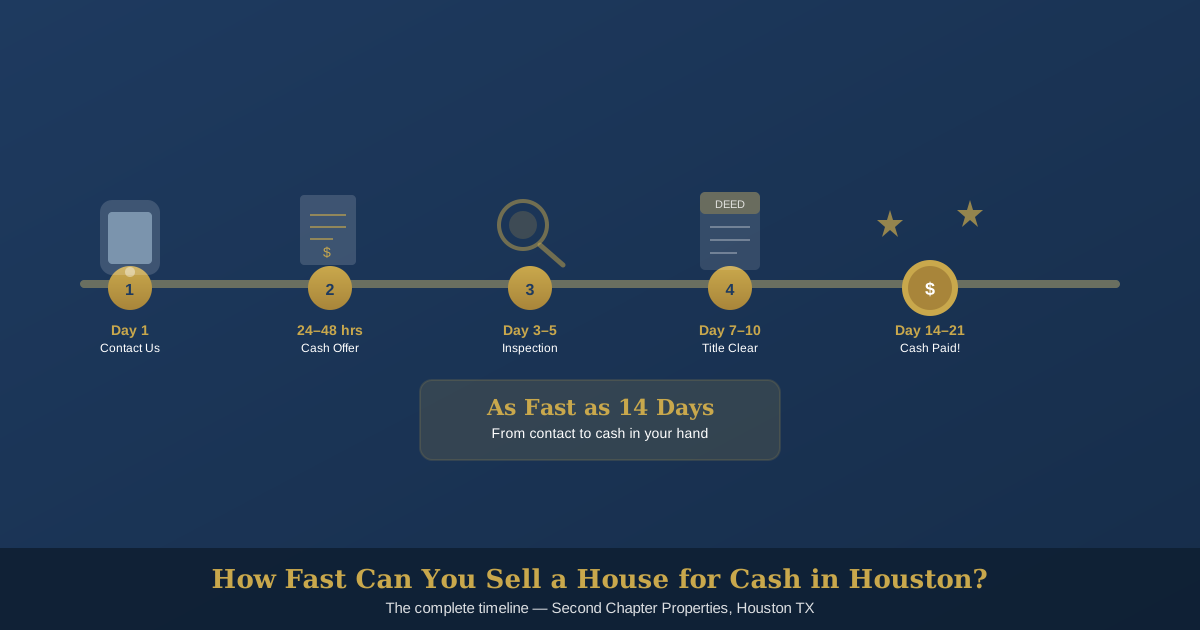
“How fast can I sell my house for cash in Houston?” is one of the most common questions motivated sellers ask when they first reach out to a cash buyer. The honest answer is: it depends on a handful of factors, but a cash sale is reliably faster than listing with a realtor — and the speed advantage compounds when the seller is dealing with a pressing situation like a foreclosure deadline, a corporate relocation, an estate that needs to be settled, or a property that has been vacant long enough to attract code enforcement attention. This post walks through the realistic timeline for a Houston cash home sale and explains what compresses or stretches that timeline.
The Short Answer: 7 to 30 Days in Most Cases
Most Houston cash home sales close within 14 to 21 days from initial contact to funded closing. The fastest possible close — in genuine emergency situations — is 7 days. The slowest close with an uncomplicated transaction is typically 30 days, usually because one party needs extra scheduling time.
Here is how a standard Houston cash sale timeline looks day by day:
Day 1 to 2: The seller contacts the buyer. The buyer gathers basic property information — address, approximate condition, outstanding mortgage balance, and any known liens. An in-person walkthrough or photo review is scheduled. For sellers in urgent situations, the walkthrough and offer can happen the same day.
Day 2 to 3: The buyer reviews comparable sales in the HCAD system (Harris County Appraisal District) and in active market data, then presents a written cash offer. The seller reviews, potentially negotiates minor terms, and signs a purchase agreement.
Day 3 to 14: The buyer orders a title search through a Texas title company. The title company searches HCAD records, Harris County deed records, court judgment records, and tax records to produce a title commitment — the document that identifies any liens, encumbrances, or ownership defects that must be resolved before closing. A clean title search takes 3 to 7 business days.
Day 10 to 17: Once the title commitment is issued with no material issues, the title company schedules a closing date, prepares the deed, settlement statement, and all transfer documents.
Day 14 to 21: Closing day. Both parties sign at the title company’s office (or via remote online notarization if an out-of-state party is involved). The deed is recorded with the county clerk. The wire transfer to the seller’s bank account is initiated, with funds typically arriving the same day or the next business morning.
Compare this to a listed sale: 1 to 30 or more days on the market waiting for a buyer, then 30 to 45 additional days for the buyer’s mortgage underwriting, inspection, appraisal, and lender approval. Total elapsed time for a listed sale in the current Houston market: 60 to 120 days, with no guarantee the deal closes even after 90 days of waiting.
What Determines How Quickly Your Houston Cash Sale Closes?
Not every cash sale moves at the same pace. Five factors have the largest influence on closing speed.
Factor 1 — Title clarity. A property with clear title — no outstanding liens, no ownership disputes, no pending lawsuits, no unresolved probate — can close in 7 to 14 days. When the title search comes back clean, the title company can schedule closing almost immediately. Outstanding liens paid from the sale proceeds do not necessarily delay closing; the title company coordinates the payoff wires at closing. The delay happens when there are disputes about the amount owed, when lienholders are unresponsive, or when there are multiple competing claims to the property.
Factor 2 — Probate status. If the property is owned by a deceased person’s estate, closing cannot happen until the executor has been formally appointed by a probate court and issued Letters Testamentary (or Letters of Administration if there is no will). In Harris County, the Probate Court handles estate administration, and even an uncontested application for independent administration typically takes 3 to 6 weeks from filing to the issuance of Letters. During that waiting period, no sale can close regardless of how fast the buyer moves. Sellers with inherited properties who want to move quickly should file for probate as soon as possible — the earlier you start, the sooner Letters are issued and the sooner closing can happen.
Factor 3 — Buyer’s capital. Not all “cash buyers” have liquid funds. Some buyers who market themselves as cash purchasers are actually using hard money loans, private investors, or transactional funding that has conditions attached. When a buyer’s capital has conditions — such as a proof-of-funds requirement from a silent investor, or a funding contingency tied to selling another property — closing can be delayed or fall through entirely. True cash buyers can provide a Proof of Funds letter from their bank showing liquid funds available to close. Before signing a purchase agreement, request this letter. A legitimate cash buyer has no reason to refuse.
Factor 4 — Title company scheduling. Reputable Texas title companies handle closings efficiently, but they have schedules. During peak real estate periods — spring and early summer in Houston, as well as the end of each calendar quarter when investors often close multiple deals — title company availability can push closings out by 5 to 10 business days. Year-end closings in December are often compressed into a two-week window that creates scheduling pressure. For a truly urgent timeline, ask the buyer if their title company can prioritize your closing; buyers with established relationships at title companies can often expedite scheduling.
Factor 5 — Seller scheduling. This factor is underestimated. After decades of homeownership, sellers often need time to move out, remove belongings, coordinate family logistics, or sort through the contents of a property that has been partially occupied. Many sellers who contact a buyer citing an urgent timeline then discover they need three weeks to actually vacate and are ready to close. Your timeline is ultimately set by when you are ready to hand over the keys. Many cash buyers, including Second Chapter Properties, can accommodate a leaseback arrangement — closing on the buyer’s schedule while the seller remains in the property for a short period after closing, paying nominal daily rent.
Houston-Specific Factors That Can Affect Your Timeline
Houston has several local characteristics that cash buyers and sellers need to account for in the transaction timeline.
Harris County Appraisal District records. HCAD maintains publicly accessible online records for all properties in Harris County, which significantly speeds up the initial title research phase. A buyer or their title company can quickly confirm ownership history, assessed value, and tax payment status through the HCAD portal. For sellers who are delinquent on property taxes, HCAD records will show the outstanding amount and any active tax liens. These liens are paid at closing from the sale proceeds and do not need to be resolved before the closing is scheduled — but they must be accounted for in the payoff calculations.
Flood zone and insurance considerations. The Houston metro area includes numerous flood-impacted zones — Cypress Creek, Addicks and Barker reservoir areas, Kingwood, Bear Creek, and portions of the Energy Corridor, among others. Properties in these areas may have unresolved FEMA flood claims, outstanding National Flood Insurance Program payoffs, or title issues stemming from prior flood damage. When a property was damaged and insurance proceeds were paid, the insurer’s interest in the property must be resolved in the title search. These situations add 1 to 3 weeks to the title research phase, but they are resolvable with the right title company.
MUD and HOA dues in suburban communities. Houston’s suburban communities — Katy, The Woodlands, Cypress, Sugar Land, Pearland, and others — often sit within Municipal Utility Districts (MUDs) that function alongside, or independently from, standard HOA dues. Both MUD assessments and HOA dues must be confirmed as current, and any delinquent amounts must be cleared at closing. Getting an accurate status letter from an HOA or MUD can sometimes take 5 to 10 business days if the management company is slow to respond. Sellers in these communities should request an account status letter from their HOA or MUD as soon as they decide to sell, rather than waiting for the buyer’s title company to do it.
Energy Corridor and Katy area corporate relocations. The Energy Corridor between Highway 6 and Beltway 8 along Interstate 10 is home to major oil and gas companies whose employees frequently need to sell quickly when transferred or laid off. Many of these sellers need 30 to 45 days of continued occupancy after closing to complete the relocation, coordinate household moves, and transition family members out of Houston-area schools. Cash buyers in Houston commonly accommodate these situations with post-closing occupancy agreements — the seller signs the deed at closing, receives their proceeds, and then pays a nominal daily occupancy fee while completing the move. This arrangement is also called a seller rent-back, and it is one area where cash buyers have significant flexibility that listed transactions typically do not.
Multiple-county properties and dual title searches. Some Houston-area properties straddle county lines — sections of Katy span Harris, Fort Bend, and Waller counties; League City properties may involve both Galveston and Harris counties; Cypress properties may sit in Harris or Waller county depending on the address. Properties near county lines sometimes require a title search in two counties, which adds time and cost. Confirm with your buyer which county the property is recorded in before estimating the closing timeline.
The Fastest Realistic Houston Cash Sale: 7 Days
A 7-day close is achievable, but it requires every factor to align simultaneously. The property must have clear title with no outstanding liens beyond a single first mortgage with a known payoff. The seller must be ready to vacate or sign a day-of-closing move arrangement. The buyer must have liquid funds available without any third-party conditions. The title company must have immediate availability for a rush close. And all parties — buyer, seller, lender holding the mortgage, and title company — must be responsive and available throughout the week.
In practical Houston terms, this scenario most often arises in pre-foreclosure situations. A homeowner who receives a Notice of Sale and has a first-Tuesday auction in 14 days has limited time but a clear objective: close before the auction date. Second Chapter Properties has completed 7-day closings in Harris County for sellers in exactly this situation — clear equity above the loan balance, motivated seller ready to act, and a title company able to run a priority search and schedule closing within the week. The key is contacting a buyer the moment the Notice of Sale arrives, not waiting until the week before the auction.
Common Delays and How to Avoid Them
Delay 1 — Waiting too long to contact a buyer. The most preventable delay is also the most common. Sellers who receive a foreclosure notice, an estate settlement letter, or a corporate relocation notice often wait weeks before reaching out to a buyer, believing the situation is not urgent. By the time they contact a buyer, the timeline is compressed to the point where the fastest close is no longer achievable. If you know you will need to sell, contact a buyer as early as possible — even before you have made a final decision. Getting an offer and understanding your options costs nothing.
Delay 2 — Missing documents. Sellers who cannot locate the original deed, cannot produce a death certificate for a deceased co-owner, have a marital status change not yet recorded in county records, or have a prior lien release that was never filed with the county create title complications that can add 2 to 4 weeks. Gather your documents before you contact a buyer: deed, any payoff statements from lienholders, death certificates if applicable, and any divorce decree that affects property ownership.
Delay 3 — Multiple owners in disagreement. A cash sale cannot close if all owners of record do not sign the deed. If a co-owner refuses to sign — a situation that arises most frequently in inherited properties with multiple heirs, in divorce situations where one party is uncooperative, or in older co-ownership arrangements between siblings or relatives — the sale cannot proceed without a court order. Partition lawsuits, which force a sale when co-owners cannot agree, can take a year or more to resolve in Texas courts. The most practical preventive step is reaching consensus among all owners before contacting a buyer.
Delay 4 — Unresolved probate. As noted above, if the owner of record is deceased and no probate proceeding has been initiated, the property cannot be conveyed until the estate is administered. This is not a delay imposed by the buyer; it is a legal requirement. Contact a Texas probate attorney as soon as possible if the owner of record is deceased — the sooner Letters Testamentary or Letters of Administration are issued, the sooner the sale can close.
Delay 5 — Unpaid HOA or MUD dues in Houston suburbs. In Katy, The Woodlands, Cypress, and other MUD-heavy communities, HOA and MUD dues must be cleared before or at closing. An unpaid MUD district balance can hold up a sale if the MUD district disputes the payoff calculation or is slow to issue a release. Requesting an account status letter from your HOA and MUD district at the outset of the sale process, rather than waiting for the title company to request it, can save 5 to 10 business days.
Comparing Cash Sale Speed to Other Selling Methods
For a seller with a time-sensitive situation, the comparison to other methods makes the cash sale advantage clear.
A cash home sale closes in 7 to 30 days, requires no repairs, and involves no real estate commission. The seller receives the net proceeds at closing after the mortgage payoff and any other liens are satisfied.
An iBuyer — a company like Opendoor or Offerpad — can sometimes close in 14 to 45 days, but requires a completed inspection and charges a service fee ranging from 5 to 8 percent of the sale price. The service fee is not a commission in name, but it functions as one: it reduces the seller’s net proceeds. iBuyers also typically require the property to meet certain condition standards and will decline properties with significant deferred maintenance, flood damage, or title complications.
A listed sale with a realtor takes 60 to 120 days on average in the Houston market when you include the time on market plus the buyer’s financing period. Realtors charge 5 to 6 percent in commission (split between buyer’s and seller’s agents), and most buyers requesting a financed purchase will also request repairs based on the inspection report. For a seller who needs to move in 30 days, a listed sale is simply not a viable option.
A for-sale-by-owner (FSBO) sale eliminates the commission but shifts all of the management burden to the seller — marketing, showing, negotiating, and managing the transaction. FSBO sales in Houston typically take 30 to 90 days or more to close, depending on pricing and demand. And most FSBO sales ultimately attract financed buyers, not cash buyers, which means the closing is still subject to a 30 to 45 day financing period after a contract is accepted.
For a motivated seller with a time-sensitive situation — foreclosure, relocation, estate settlement, vacancy — the cash sale advantage over listing is measured in months, not days.
What Happens on Closing Day?
A Texas residential closing at a title company is a straightforward process. Both the buyer and seller (or their authorized representatives, including a power of attorney for out-of-state sellers) appear at the title company’s office and sign a stack of documents that includes the deed, settlement statement, transfer documents, and any payoff authorizations.
Once the documents are signed and notarized, the title company transmits the signed deed to the county clerk for recording. In Harris County, deeds can often be recorded electronically and same-day, confirming the transfer of ownership immediately. The title company then initiates the wire transfers: the seller’s mortgage lender receives the payoff, any other lienholders receive their amounts, and the seller receives the net proceeds — the sale price minus all payoffs and prorated taxes — in a wire transfer to their designated bank account.
Wire transfers from a Texas title company closing typically arrive in the seller’s account the same day the closing occurs, if the closing happens in the morning. Closings in the afternoon may result in funds arriving the next business morning due to bank wire cutoff times. If the seller prefers a cashier’s check rather than a wire, that can also be arranged.
The seller is not responsible for making any payments at closing in a standard cash home sale. All payoffs — mortgage, liens, delinquent taxes, HOA dues, MUD dues, and prorated property taxes through the closing date — are deducted from the sale proceeds before the net amount is wired to the seller.
Getting Your Timeline Started
Second Chapter Properties closes cash purchases in Houston in as few as 7 days for urgent situations and typically 14 to 21 days for standard transactions. We handle pre-foreclosure closings, estate sales, relocation sales, and any other situation where speed matters.
If you want to understand exactly how our process works from first contact to funded closing, read about how it works. We serve Houston, Katy, Sugar Land, Pearland, Spring, The Woodlands, Cypress, Baytown, League City, Pasadena, and all surrounding areas. Or skip straight to the conversation: call (346) 770-2102 for a no-obligation discussion about your timeline and what a cash offer might look like for your property.